

Sports as a Catalyst for Mathematical Thinking

Mathematics Teacher, National Hill View Public School, Rajarajeshwari Nagar, Bengaluru
When the Playground Becomes a Mathematics Classroom
Have you ever watched a cricket ball disappear over the boundary, a basketball sail towards the hoop, or a runner cross the finish line—and wondered how much mathematics happened before that moment? A player may never stop to write an equation, yet the mind is constantly calculating. How far is the target? What angle should I choose? How fast is the ball moving? How much time do I have? Which strategy is more likely to work?
Without realising it, the player is doing mathematics. This is where an interesting question emerges: What if the playground itself could become a mathematics classroom?
The Mathematics We Do Without Knowing
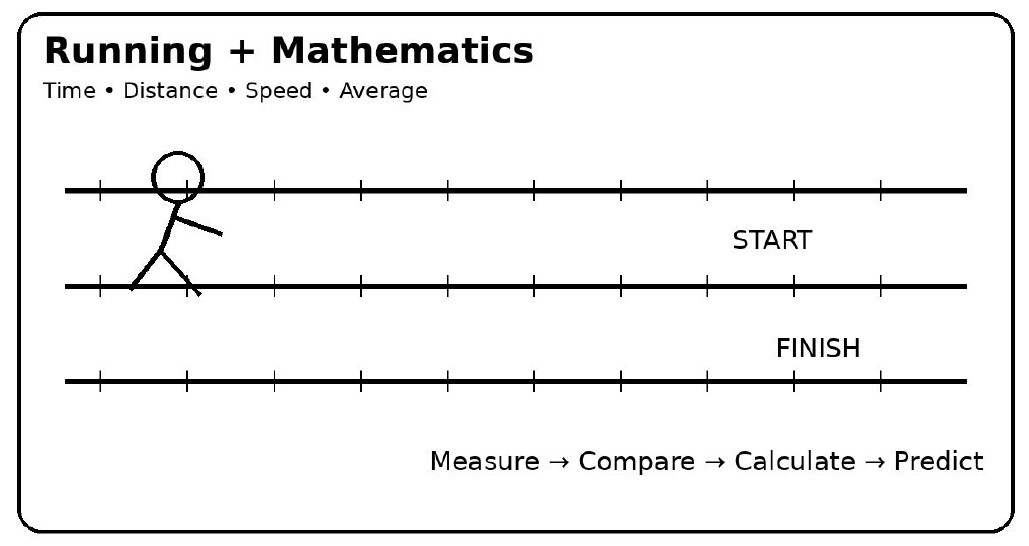
Running activity: mathematical thinking through time, distance and speed.
Running activity: mathematical thinking through time, distance and speed.
Imagine a group of students standing beside a running track. One student starts the stopwatch while another races towards the finish line. When the runner completes the race, the students immediately begin comparing their timings.
“Who was faster?” “How much faster?” “What was the average time?” “Can we predict the time if the distance is increased?”
At first glance, this appears to be simply a sports activity. But beneath the excitement of the race are mathematical ideas—measurement, time, distance, speed, comparison, averages and prediction. This is the beauty of sports-integrated mathematics. Students do not encounter mathematics as an isolated collection of formulas. Instead, they experience a situation first and then use mathematics to understand it. The mathematics moves from the textbook to the real world.
A Cricket Match Is More Than Runs
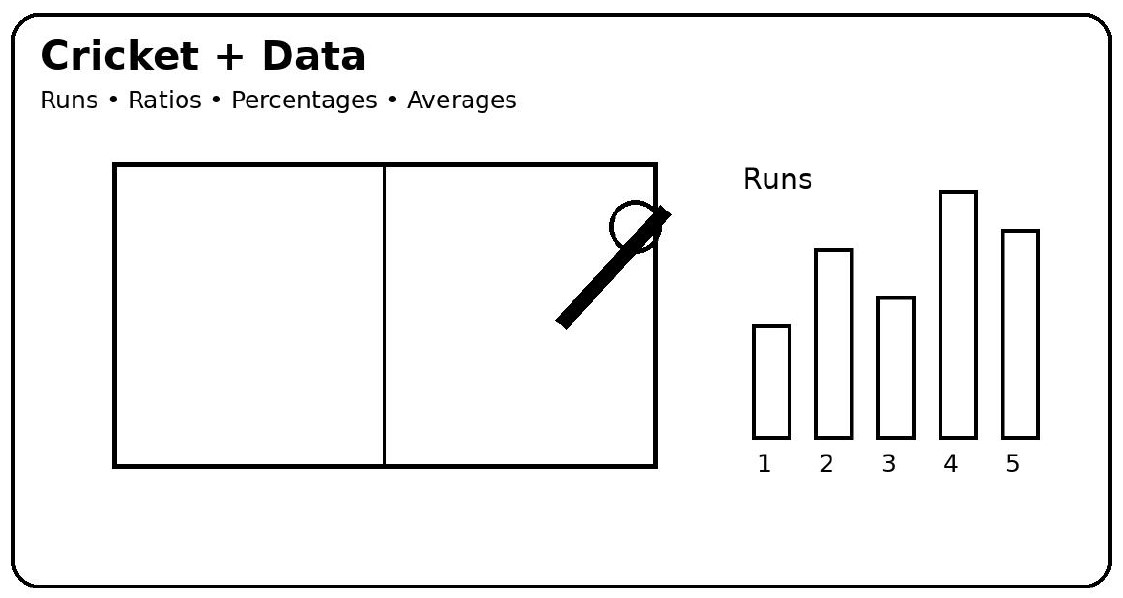
Cricket data: turning scores into averages, ratios, percentages and comparisons.
Cricket data: turning scores into averages, ratios, percentages and comparisons.
Consider a cricket match. A student watching a batsman may simply see runs being scored. A mathematics teacher, however, can see a treasure trove of mathematical possibilities.
Suppose two players have scored runs in several matches. Who is the better performer? Is it enough to look at their total runs? What if one player has played more matches? What if one player scores consistently while the other scores brilliantly in only a few matches?
Suddenly, students are working with averages, ratios, percentages and rates. They can collect actual scores, organise them into tables, calculate averages and represent the information through graphs.
But the most interesting question is no longer “Find the average.” Instead, it becomes: “Which player is more consistent, and how can you prove it mathematically?”
That small change in the question creates a major change in thinking. Students are no longer merely calculating. They are interpreting, comparing, reasoning and justifying.
When a Basketball Court Becomes a Geometry Lab
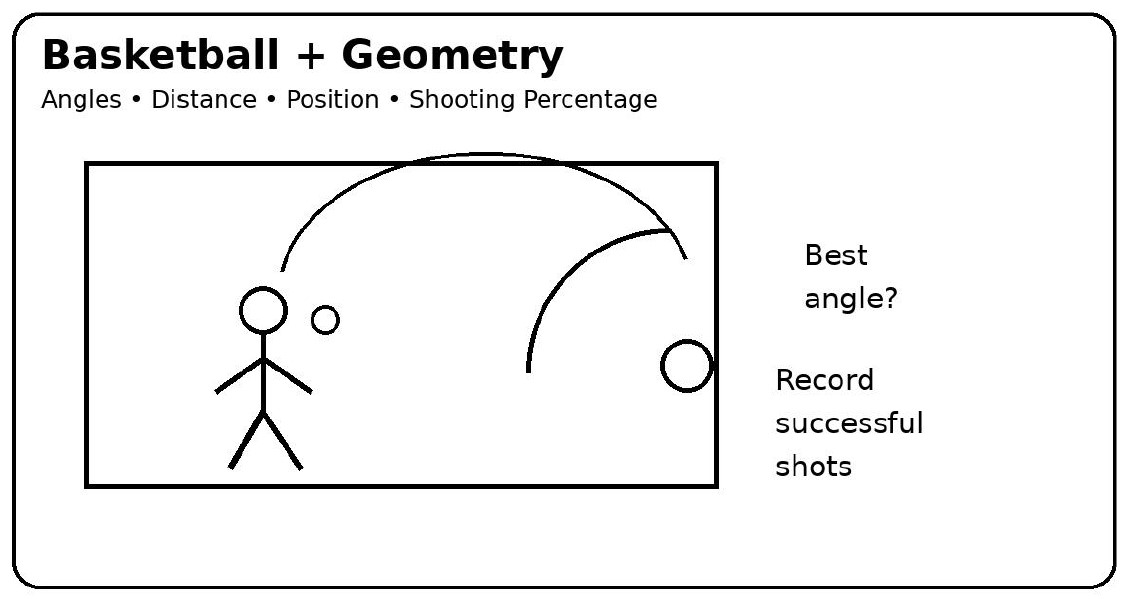
Basketball geometry: exploring angle, position, distance and performance.
Basketball geometry: exploring angle, position, distance and performance.
Imagine a basketball player standing on the court, preparing to shoot. The player looks at the basket, adjusts their position and takes the shot.
What did the player actually consider? Perhaps distance. Perhaps direction. Perhaps position. Perhaps the angle of the shot.
A mathematics teacher can transform this simple sporting moment into an investigation: “From which position on the court would a player have the best angle to score? Can you justify your answer?”
Suddenly, the basketball court becomes a geometry laboratory. Students can explore angles, distance, position, measurement and statistics. They can record successful and unsuccessful shots, calculate shooting percentages and investigate whether position influences performance.
The question is no longer simply about obtaining an answer. It becomes about finding evidence for an answer.
The Silent Mathematics of Goalball
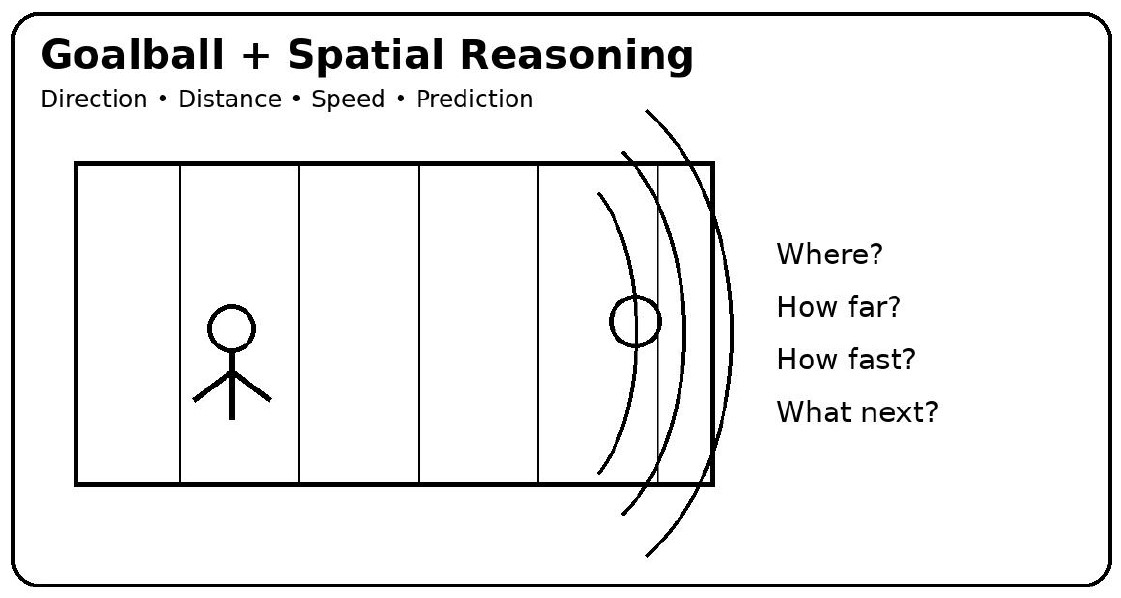
Goalball: spatial reasoning, estimation, prediction and decision-making.
Goalball: spatial reasoning, estimation, prediction and decision-making.
One of the most fascinating examples is Goalball. Players depend heavily on sound and spatial awareness to judge the direction, distance, speed and position of the ball. They have to predict its movement and respond quickly.
There may be no visible equation in front of the player, but mathematical thinking is taking place continuously. The player estimates where the ball is, how far away it is, in which direction it is moving, how quickly it might reach a particular position, and what response should be made.
This reveals something important about mathematics: mathematical thinking is not limited to calculation. It includes estimation, spatial reasoning, pattern recognition, prediction and logical decision-making.
The student begins to understand that mathematics is not simply something that happens when a textbook is opened. It is a way of making sense of situations.
From Player to Mathematical Investigator Students
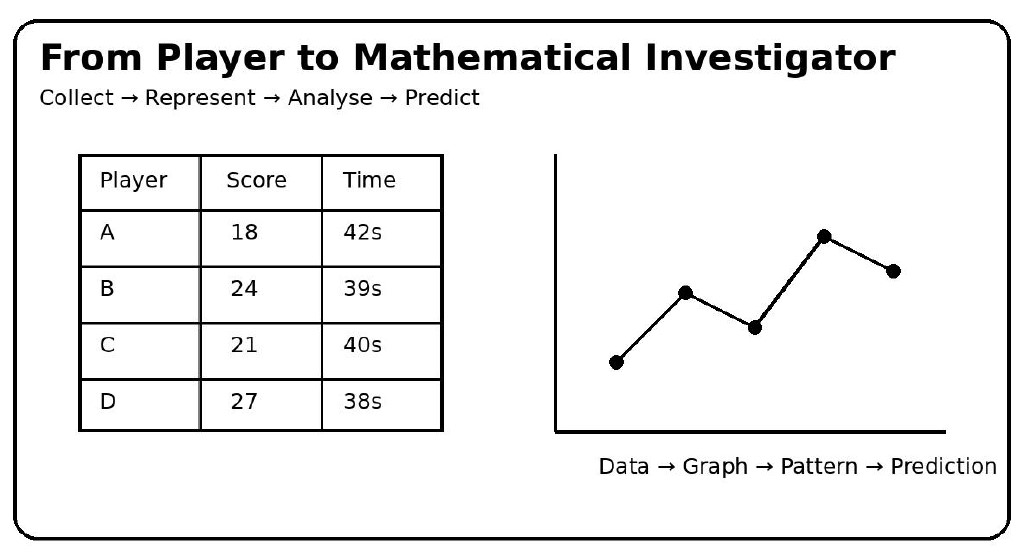
Students become investigators by collecting, representing and analysing sports data.
Students become investigators by collecting, representing and analysing sports data.
Now imagine taking students onto the school playground and giving them a simple challenge: “Can you collect enough data from a game to make a mathematical prediction?”
The students begin recording scores, timings, distances or successful attempts. One group creates a table. Another draws a graph. Another calculates averages and percentages. Someone notices a pattern. Another student questions the pattern. A discussion begins.
Suddenly, the classroom has changed.
Students are not waiting for the teacher to provide every step. They are observing, investigating, calculating, discussing, analysing and drawing conclusions.
This is the heart of sports-integrated pedagogy. A running activity can introduce time, distance and average speed. A basketball activity can introduce percentages and statistics. A sports field can provide opportunities for geometry, angles, coordinates and measurement. A game can become a source of data, patterns and probability.
The sport provides the situation; mathematics provides the language to understand it.
What Happens When We Change the Question?
Perhaps one of the most powerful changes a teacher can make is not changing the activity—but changing the question.
Instead of “Calculate the average score,” ask, “Which player performed most consistently? How can you prove it?”
Instead of “Find the angle,” ask, “From which position would the player have the best opportunity to score? Why?”
Instead of “Calculate the percentage,” ask, “What does this percentage actually tell us about the player's
performance?”
Instead of “Draw a graph,” ask, “What can the coach learn from this graph?”
The mathematics remains the same, but the thinking becomes deeper. Students begin to question, predict, justify, interpret and defend their conclusions.
That is mathematical thinking.
More Than Mathematics
Sports-integrated mathematics also develops skills that extend far beyond the mathematics classroom.
When students work together to collect sports data, they learn collaboration. When they explain why their conclusion is valid, they develop communication. When they compare different strategies, they practise critical thinking. When they face an unfamiliar problem, they develop problem-solving skills. When they use evidence to select a strategy, they practise decision-making. When they interpret tables and graphs, they develop data literacy. When they find different ways to solve a problem, they exercise creativity.
The playground, therefore, becomes more than a place for physical activity. It becomes a place where students learn to think with evidence.
The Teacher's Perspective
As mathematics teachers, we sometimes face a familiar challenge. A student may ask: “Where will I ever use this?”
Sports can provide one answer.
We can tell students about averages, percentages, angles, speed and probability. But when students actually use these concepts to understand a game, something changes. They begin to see the purpose behind the mathematics.
The formula is no longer just a formula. The percentage represents a player's performance. The average represents a pattern in real data. The angle represents a possible path towards a target. The graph tells a story. The calculation supports a decision.
Mathematics begins to have meaning.
From Textbook to Playing Field
This approach does not mean that textbooks, formulas or traditional mathematical methods are unnecessary. Rather, sports provide a meaningful context in which those mathematical concepts can come alive.
The journey can be as simple as:
Observe → Measure → Record → Calculate → Represent → Analyse → Predict → Justify
And somewhere along this journey, students make an important discovery: Mathematics is not only about finding the answer. It is about understanding why the answer makes sense.
The research referenced in the source article also points towards a positive relationship between sports activities and mathematics learning across cognitive, psychological and social dimensions, including mathematical thinking, problem-solving, concentration, motivation, teamwork and communication.
The Playground as a Living Mathematics Laboratory
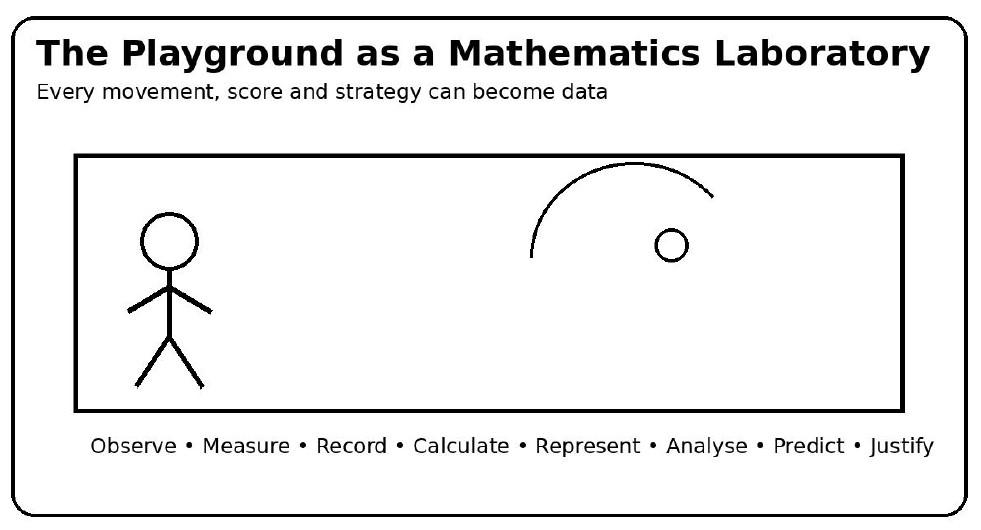
The playground as a living mathematics laboratory.
The playground as a living mathematics laboratory.
So, can a playground really become a mathematics classroom?
Absolutely.
Every movement can involve measurement. Every position can involve geometry. Every score can generate data. Every strategy can involve reasoning. Every performance can be compared. Every pattern can lead to a prediction. Every decision can involve mathematics.
As teachers, perhaps our greatest opportunity is not merely to teach students more mathematics, but to help them notice the mathematics that already exists around them.
The next time students run across the playground, calculate a score, throw a ball, jump a distance or analyse the result of a game, we can ask them to pause for a moment and look again.
Behind the running is speed. Behind the shooting is angle. Behind the score is data. Behind the strategy is reasoning. Behind the prediction is probability. And behind the game is a mind constantly thinking mathematically.
Closing Thought
Perhaps the most exciting mathematics classroom was never enclosed by four walls. Perhaps it was waiting for us on the playground all along. When students play, observe, measure, predict and analyse, they are not merely playing a game—they are learning to think mathematically. And when a student finally looks at a game and says, “I can see the mathematics in this,” the real goal of mathematics education has begun: not simply to teach students how to calculate, but to help them see, question and make sense of the world.
About the Author
Ms Bharati CS is a passionate Mathematics Teacher at National Hill View Public School, Rajarajeshwari Nagar, Bengaluru, with rich teaching experience across different parts of India. Her experience of working with students from varied backgrounds has shaped an adaptable and inclusive approach to teaching.
She believes Mathematics goes beyond numbers and formulas, nurturing logical thinking, problem-solving, curiosity, and confidence. Through learner-centred, experiential, and activity-based approaches, she strives to make mathematical concepts meaningful, engaging, and connected to real-life situations.
Mathematics Teacher, National Hill View Public School, Rajarajeshwari Nagar, Bengaluru